23 October 2026
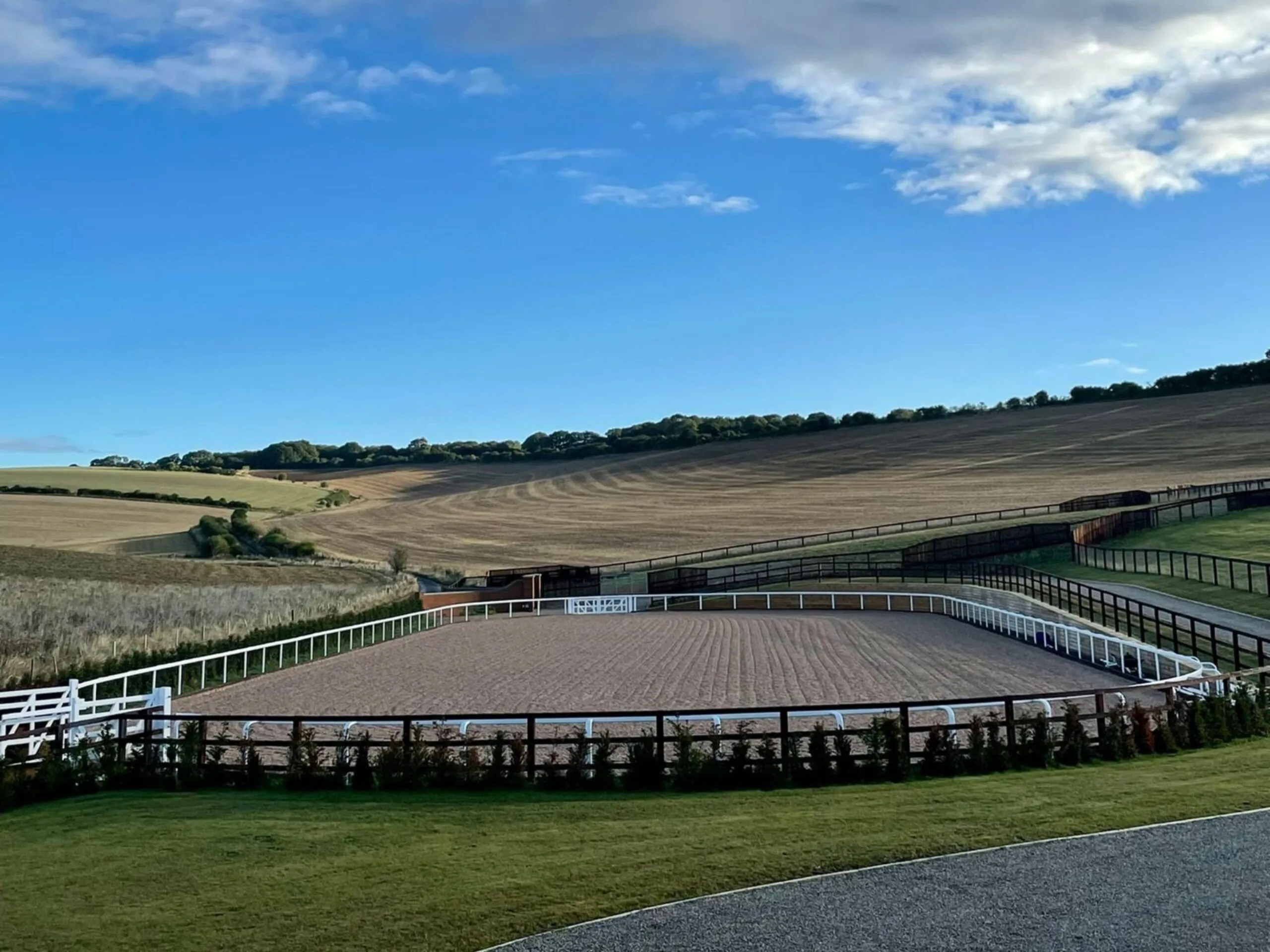
An Ebb and Flow arena is a riding arena watered from below. The riding surface sits on a sealed liner, and a network of pipes raises or lowers a water table inside the stone layer beneath it. The sand draws moisture up evenly, so the going stays consistent in a dry summer and drains in heavy rain, without the use of sprinklers. We design, supply and build our own Ebb and Flow system. Prices start from around £125,000 ex VAT for a 60 x 30m arena, excluding the perimeter gravel path.
How does an Ebb and Flow arena work?
Think of the firm, damp sand along the waterline of a beach. An Ebb and Flow arena recreates that surface, and you control how firm or soft it rides by raising or lowering the water level beneath it.
Water is fed into a fill chamber beside the arena and flows by gravity through perforated pipes under the surface. It fills the stone layer beneath the sand up to a level you set, and the sand above draws that moisture up by capillary action. The surface is kept damp from below instead of drying out on top.
To change how the arena rides, you change the water level. Raising or lowering it changes how much moisture reaches the surface. In heavy rain, surplus water drains down through the sand and out through the empty chamber, so the water level holds and the surface does not puddle. In a dry spell, the fill chamber tops the level back up.
How is an Ebb and Flow arena built?
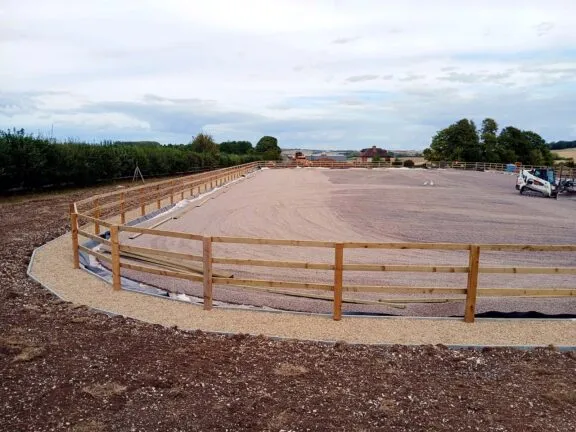
We designed our own system, with input from a German Ebb and Flow specialist who has designed multiple arenas internationally. It is built in layers, from the bottom up:
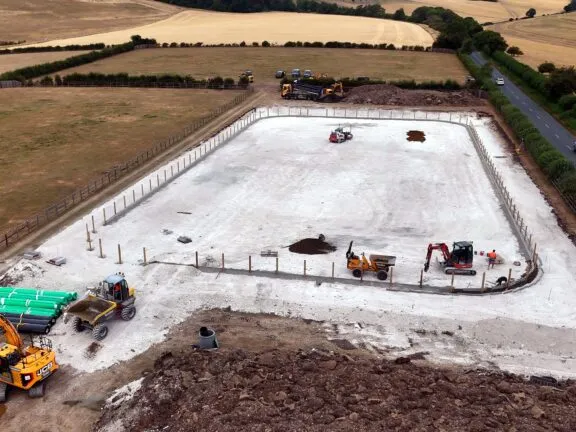
- Formation. We form a smooth, perfectly level base, using laser-guided machinery. Water finds its own level, so if the base is not level, parts of the surface will ride differently to others.
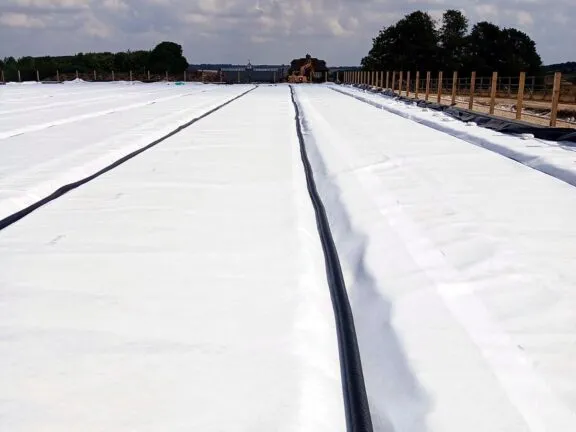
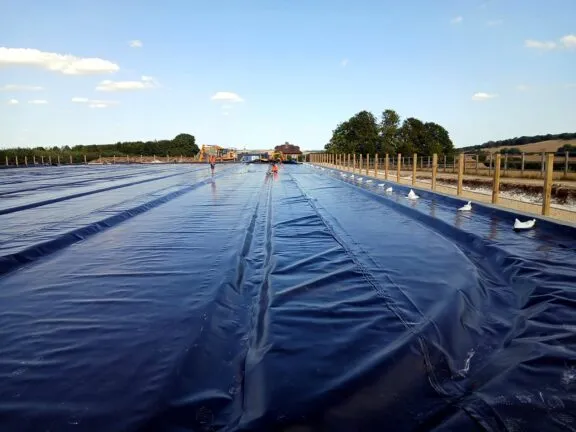
- Liner. A waterproof liner is installed to make the arena watertight. It is usually laid between layers of thick non-woven geotextile, which protects it from puncture.
- Pipe network. Perforated pipework installed across the arena evenly distributes and collects water.
- Reservoir stone. A layer of clean, washed angular stone covers the pipes. The gaps between the stones hold the water.
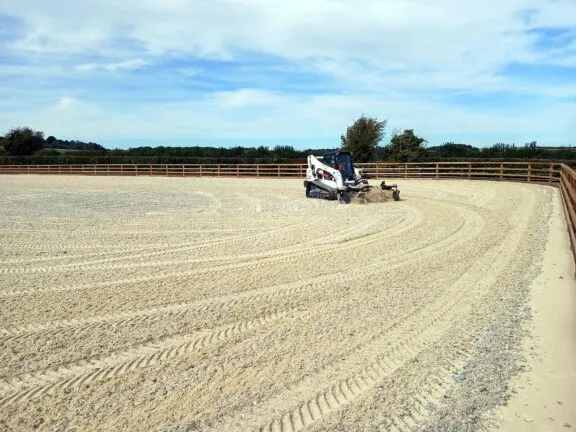
- Riding surface. Specialist sand with fibre, a mix chosen for its performance in Ebb and Flow systems.
- Control chambers. Everything within the arena runs by gravity. One chamber fills the arena from your water supply and one empties it. Setting the level in the chambers sets how damp the surface is. For larger arenas, multiple chambers may be required.
A concrete kerb retains the arena build-up and secures the liner edge. We recommend a one-metre gravel path around the outside, which acts as a French drain and stops run-off from the surrounding ground reaching the arena.
For how a conventional arena is built, see our step-by-step guide to building an outdoor arena.
Why choose an Ebb and Flow arena?
- Consistent going all year. Moisture comes up evenly from below rather than being sprayed on by overhead sprinklers, which wet the surface unevenly and lose more water to wind and evaporation.
- Far less water. Overhead sprinklers can use up to 10 litres per square metre per day in summer, much of it lost to wind and evaporation. An Ebb and Flow system uses far less, because the water is held below the surface rather than sprayed over it.
- Water can be reused. When the arena is drained, the water can go back to a storage reservoir rather than to waste.
- Less dust, no puddles. The sand stays damp, so it does not turn to dust in a dry summer. After heavy rain, the excess water drains away through the system instead of sitting on the surface.
- Holds up to heavy use. Ideal for busy training yards, professional yards, livery yards and competition venues. Moisture is controlled from below, so the surface does not dry out quickly, hold water where traffic is heaviest, or track up deeply.
How does Ebb and Flow compare with waxed and sand and fibre arenas?
| Ebb & Flow | Waxed | Sand & Fibre | |
|---|---|---|---|
| Watering | From below | Not usually needed | Overhead sprinklers |
| Water use | Low, reusable | Little or none | Up to 10 L/m²/day |
| Summer dust | Minimal | Low, varies with wax content | Depends on watering |
| Control of the going | Adjustable water level | Varies with temperature and harrowing | Varies with watering and weather |
| Maintenance | Harrowing, water level, optional annual service | Harrowing, wax top-ups, optional annual service | Harrowing, watering, optional annual service |
| Site needs | Level base, water supply, outfall, power | Level base, standard construction | Level base, standard construction, sprinklers |
| Build cost | Similar to high-end wax, up to 10% more than mid-range wax | Mid to high | Lowest |
We also build waxed and sand and fibre arenas. See our equestrian arenas page for the full range.
How much does an Ebb and Flow arena cost in the UK?
From our recent quotations, a complete Ebb and Flow arena costs £60 to £70 per square metre ex VAT, for arenas from 60 x 30m to 50 x 100m.
These prices include groundworks, the full Ebb and Flow system, kerb, post and rail fencing and surface. The recommended one-metre gravel perimeter path adds around £10,000 to £15,000. Costs exclude water and electric supplies, the outfall drainage connection and planning, which depend on the site. A conversion costs more per square metre because the old surface, membrane, stone and drainage all have to come out first.
What does your site need?
- A reliable water supply, usually a borehole. Borehole water must be low in iron, because iron can clog the system, so we test it before construction starts.
- An outfall for drained water: an existing drain, a soakaway or a storage reservoir.
- A power supply for the level controllers and pumps. Pumps are only required where the ground around the arena does not give enough fall for the empty chamber to quickly drain by gravity.
- Planning permission. We can help with the application.
Is your site suitable for Ebb and Flow?
Send us your arena size, site location and water source, and we will tell you whether Ebb and Flow suits your yard and what it would cost.
Ebb and Flow Arenas: Frequently Asked Questions
It costs more to build than a sand and fibre arena. The return is lower water use, less day-to-day management and a more consistent surface over its life. Against a high-end waxed arena, the build cost is about the same.
Typically 6 to 10 weeks on site, depending on size, ground type and weather.
Yes. The building must be well ventilated, and the surface needs regular harrowing, especially in corners, so that the top layer does not stagnate.
Surplus water drains down through the stone reservoir, into the pipe network and out of the empty chamber, so the surface does not puddle.
All of them. Dressage and show jumping riders in particular choose it for the consistency and energy return of the surface.
Less well. The surface relies on regular use and harrowing to keep the moisture moving up. Left unused, the top can crust and harden, so harrow it before riding after a quiet spell.
In hard winters the top layer and control valves need managing so they do not freeze. We cover this at handover.
Regular harrowing and removing droppings, leaves and debris, as for any arena. We hand over every arena with our Surface Maintenance Guide and walk you through the water level controls. We also offer a chargeable annual service visit to keep the system and surface performing at their best. For seasonal checks on any arena, see our Springtime Arena Check.
Yes. We strip out the old surface, membrane, stone and drainage and rebuild on the same footprint. Your existing sand may be reusable, subject to testing.
More News
Posted 30 June 2026 in
Posted 11 May 2026 in Arenas , Equestrian